REGULATORY UPDATES
The 2026 PTCE Update Changed the Pharmacy Tech Exam. Here's How to Prepare.
The 2026 PTCE Update Changed the Pharmacy Tech Exam. Here's How to Prepare.
The 2026 PTCE Update Changed the Pharmacy Tech Exam. Here's How to Prepare.
The 2026 PTCE Update Changed the Pharmacy Tech Exam. Here's How to Prepare.

I remember taking the PTCE after training on the job at Rite Aid, and I remember studying alligation problems. You know, that weird math where you're calculating the percentage of ingredients in a compound, and you've got these crazy ratios to figure out. Alligation, obviously.
I scored well on alligation problems. I felt prepared for that exam. And then my first day as a pharmacy tech, I realized I had never done an alligation problem in my actual job. Not once.
What I used to do constantly, was navigate insurance rejections, trace drugs through the DSCSA system, verify DEA numbers, handle prior auth requests, interpret PBM requirements. Every single day. But the exam didn't emphasize that. The exam was built around pharmacology and compounding knowledge. And while those are important, the exam structure didn't reflect the actual job.
That changed in January 2026.
The PTCB (Pharmacy Technician Certification Board) released a completely updated PTCE that shifts the emphasis from pure pharmacology toward regulatory compliance, federal requirements, and supply chain security. And I'm going to be honest: this is actually exciting. Because this new exam is more honest about what the job actually is.
If you're studying for the 2026 PTCE, or if you're responsible for test prep in your pharmacy, you need to understand what shifted and why it matters. And here's the truth I want us to say out loud together: this update is telling us something important about where the profession is going.
What Changed: The Domain Weightings Tell the Story
Let's start with the numbers, because domain weightings are the skeleton that holds up everything else.
Federal Requirements domain: Up from 12.5% to 18.75% of the exam. That's a significant increase. From roughly 1 in 8 questions to roughly 1 in 5 questions. The entire section is now more heavily weighted than it ever has been.
Medications domain: Down from 40% to 35%. Still the largest domain, but no longer overwhelming the rest of the exam. This is a real shift. Fewer questions about specific drug interactions, mechanisms of action, and pharmacology.
Removed content:
Alligation calculations (remember those?)
Narrow therapeutic index medications as a separate category
Compounding-related questions
Added content:
DSCSA (Drug Supply Chain Security Act) material
New question formats that test application, not just memorization
This is a radical reshuffling. The exam is becoming less of a pharmacology test and more of a regulatory literacy test.
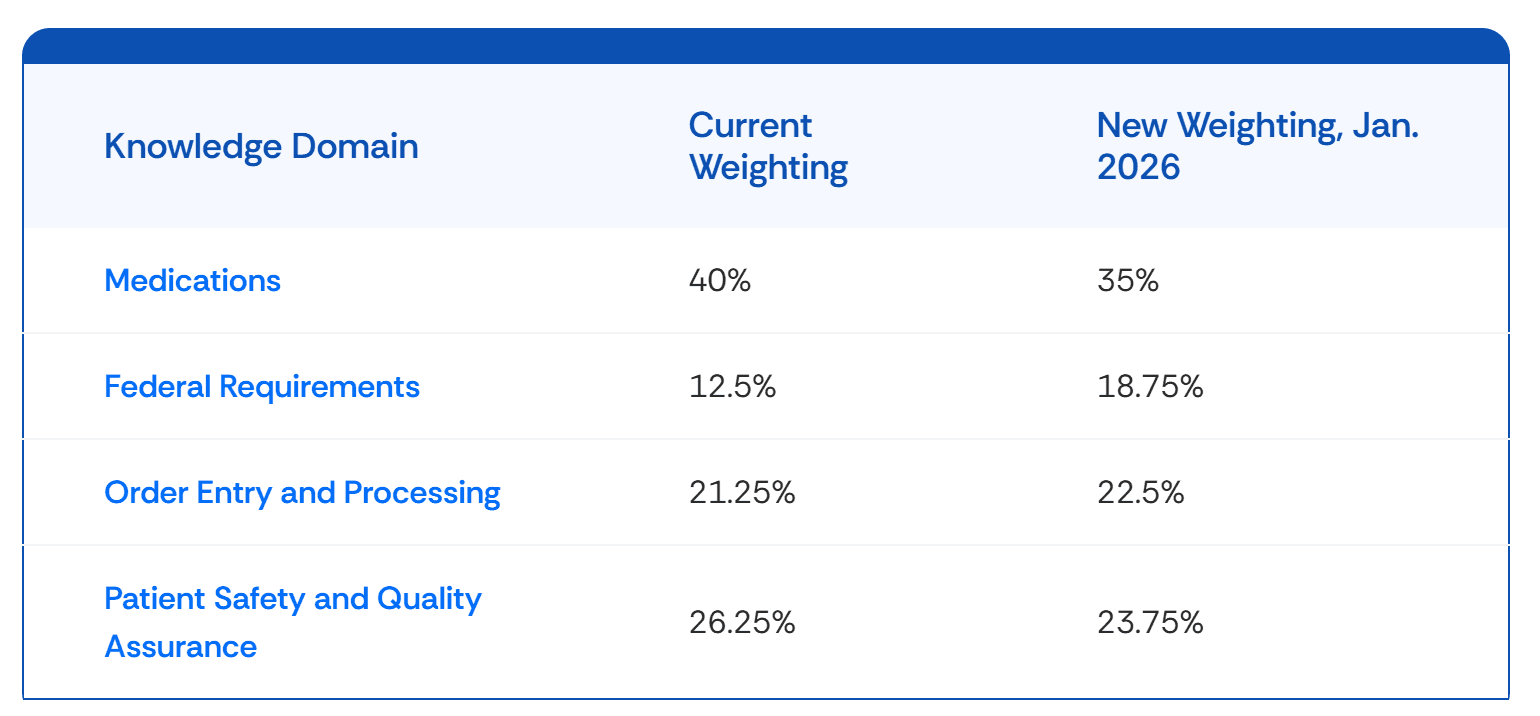
Source: Updated 2026 PTCB Syllabus: Key Changes You Should Know.
And here's why that matters: because it reflects the real job. When you walk into most community pharmacies, you spend your time managing insurance requirements, processing prior authorizations, handling DSCSA tracing when there's a recall, verifying prescriber identities, and navigating compliance requirements. You're not doing alligation math. You're problem-solving regulatory complexity.
The 2026 PTCE update is basically admitting: the exam should test what the job requires. And that's regulatory thinking, federal requirement navigation, and supply chain compliance.\
Why Federal Requirements Matter More Than Ever
Let's talk about why Federal Requirements went from 12.5% to 18.75% of the exam. It's not random. It's not bureaucratic bloat. It's because the pharmacy technician's role is evolving, and regulators have recognized that.
Consider the DSCSA itself. The Drug Supply Chain Security Act is a federal compliance framework that every pharmacy technician handles daily. It governs how drugs move through the supply chain. It requires verification of suppliers. It requires tracing if there's a recall or a product diversion issue. It requires detailed record-keeping.
Before 2026, DSCSA material was lightly covered on the PTCE. Now it's woven through the exam. And rightfully so, because a tech who doesn't understand DSCSA is a liability. They might verify a supplier incorrectly. They might not trace a recalled medication properly. They might create compliance gaps.
For independent pharmacies, DSCSA compliance is also your defense against counterfeit drugs, product diversion, and supply chain fraud. When you source from other pharmacies through RxPost, for instance, that entire transaction is DSCSA-compliant by design. And the tech who understands DSCSA, who knows how to verify suppliers, who knows what tracing looks like... that tech is the one who can confidently say, "This source is legitimate. We're compliant."

The exam shift is saying: DSCSA literacy is a core competency. Not nice-to-have. Core.
Other federal requirements that now have more weight on the exam include DEA registration and number verification, prescription validation at a federal level, Medicare and Medicaid regulations (from CMS), and Pharmacy Benefit Manager compliance requirements. These are all things that techs handle regularly, and the exam is finally catching up to that reality.
The New Question Formats: What Hot Spot and Drag-and-Drop Actually Test
The 2026 PTCE introduced new question types, and if you're used to multiple choice, these might feel different. Let me walk you through what they're actually testing.
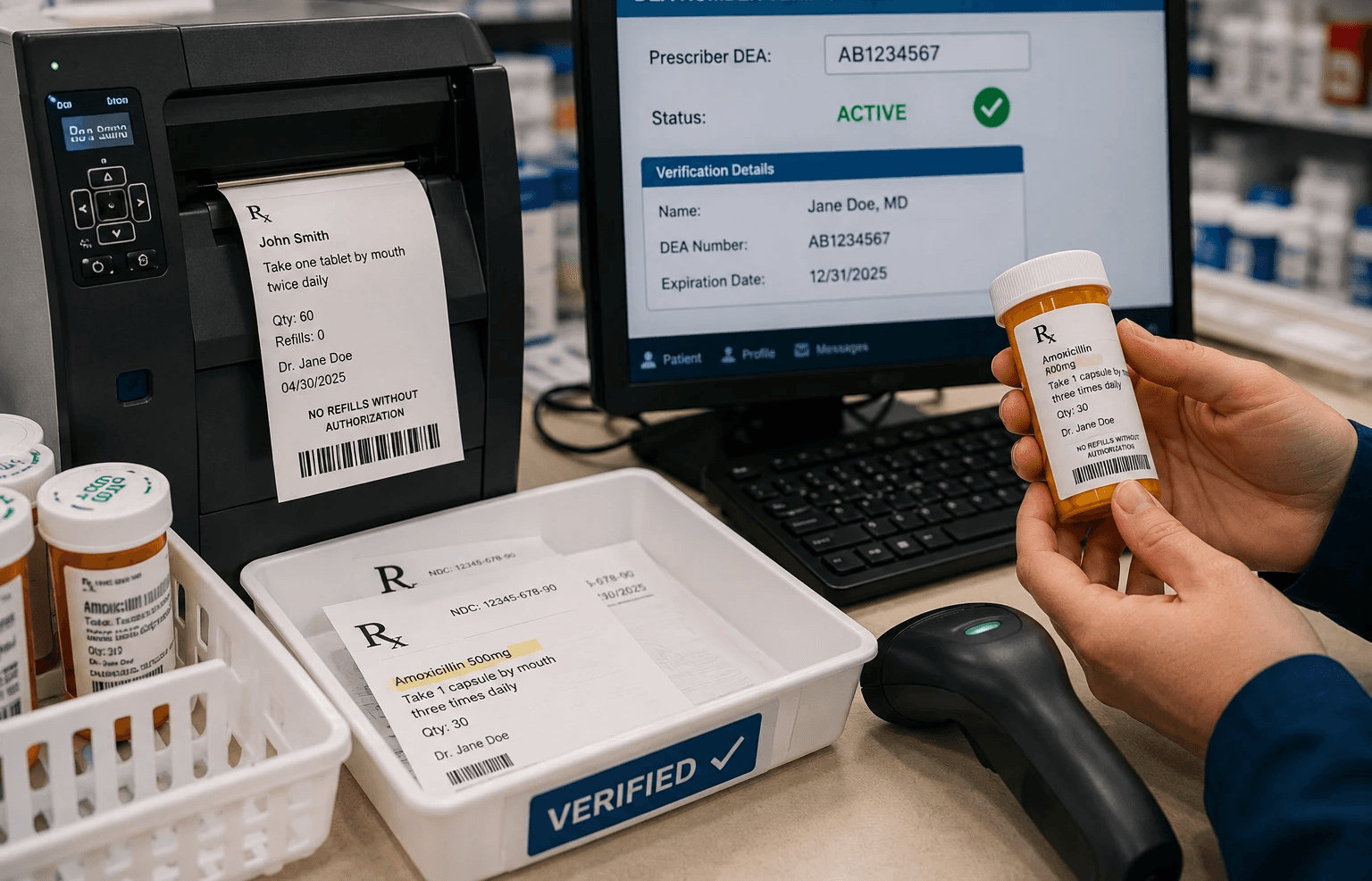
Hot Spot Questions: These show you an image (like a label on a bottle, a prescription form, or a diagram of a medication) and ask you to click on the specific area that's relevant to the question. "Click on where you would verify the DEA number on this prescription." Or "Click on the section of this label that indicates you need to perform DSCSA tracing."
What's being tested here is application, not memorization. You can't just recall facts. You have to recognize where that fact applies in a real-world context. That's actually a better test of whether a tech will catch compliance issues on the job.
Drag-and-Drop Questions: You're given a task and a series of steps, and you have to sequence them correctly. "Put these DSCSA tracing steps in the correct order." Or "Arrange these medication safety checks in the proper workflow."
Again, what's being tested is not just knowledge but procedural thinking. Can you think through a process and execute it correctly? This is closer to actual pharmacy work, where you need to know not just what to do, but in what order to do it.
These question formats are harder to study for with rote memorization. You can't just flash card your way through them. You actually have to understand the concepts deeply enough to apply them in new scenarios.
This is good for the profession. It means the techs who pass the 2026 PTCE are not just people who memorized facts. They're people who understand application.
How to Build Your 2026 PTCE Study Plan
If you're studying for the new exam, here's how to structure your preparation around the new weightings and question types.
First, audit your content priorities. The old study materials emphasized pharmacology and drug interactions. The new materials need to emphasize federal requirements, DSCSA, and compliance. If you're using old study guides, supplement them with newer materials that weight the exam the way it actually is now.
Second, prioritize DSCSA knowledge. This is not a minor topic anymore. It's about 1 in 5 questions. Understand the fundamentals:
What DSCSA requires
How to verify suppliers
How tracing works
What documentation you need
When you escalate to a pharmacist
How this intersects with pharmacy operations
Take time to understand DSCSA not as a regulatory thing you have to remember, but as a system that makes sense. Why do we trace? To protect patients from counterfeit and diverted drugs. How do we trace? We verify the chain of custody. When would we need to trace? When there's a recall, or a product safety issue, or we suspect diversion. This narrative understanding makes the concepts stick.
Third, practice with Hot Spot and Drag-and-Drop questions. These are new question types, and they require different test-taking skills. You can't rely on recognizing multiple choice answers. You have to apply concepts. Find practice materials specifically designed for these question types. Take timed practice tests so you get used to the time management and the pressure.
Fourth, understand the Federal Requirements domain holistically. Don't just memorize regulations. Understand:
Which requirements protect patients?
Which protect the pharmacy?
Which protect the supply chain?
How do they connect?
For example, DEA number verification protects against prescriber fraud. DSCSA compliance protects against counterfeit and diverted drugs. Prescription validity requirements protect against wrong patient or wrong dose. These are all different systems solving different problems. Understand the problem each one solves, and the regulation makes more sense.
Fifth, get pharmacy context. If you can, spend time in a pharmacy where you see these concepts in action. You're studying DSCSA tracing? Ask to see what a real trace looks like. You're studying DEA verification? Ask your pharmacist to show you their verification process. Contextual learning beats abstract memorization.
The Entrepreneurial Angle: Why This Exam Update Matters for Your Career
Here's what I want you to understand about the 2026 PTCE update: it's not just about passing a test. It's about recognizing what the profession is valuing.
The profession is saying: regulatory thinking is a core skill. Supply chain understanding is a core skill. Federal requirement navigation is a core skill. These are not things that only pharmacists do. These are things that pharmacy technicians do daily, and the exam is finally recognizing that.
For you, this is an opportunity. A tech who understands DSCSA deeply, who can navigate federal requirements, who thinks about supply chain compliance... that tech is valuable. That tech is practicing at the top of their license. That tech is equipped for entrepreneurial opportunities in pharmacy, whether that's building their own consulting practice, managing pharmacy operations, or understanding the economics of how pharmacy sourcing works.
When I founded RxPost, one of the things I realized is that the techs who "got it" were the ones who understood compliance and supply chain deeply. The techs who could think about DSCSA tracing, who understood why we were moving inventory from one pharmacy to another, who could verify legitimacy and compliance. Those were the entrepreneurial thinkers. And the new PTCE is basically training for that skill set.
This is not just career advice. This is the future of the profession pointing itself out.
Your PTCE 2026 Study Timeline
If your exam is within 3 months: Start immediately. Prioritize Federal Requirements (18.75% of the exam). Get familiar with Hot Spot and Drag-and-Drop question formats. Take weekly practice tests to track progress.
If your exam is within 6 months: You have time. Start with pharmacology review to maintain baseline knowledge, but spend 40% of your study time on Federal Requirements. Gradually incorporate new question format practice.
If you're helping others prepare: Make sure your study materials reflect the 2026 weightings. Emphasize DSCSA. Use practice exams that include the new question formats.
The bottom line: the 2026 PTCE is testing you on what the job actually requires. Prepare accordingly, and you'll pass it and you'll also be better equipped for the work itself.
Building the Skills That Matter for Pharmacy's Future
The 2026 PTCE update is more than an exam change. It's a roadmap showing where the profession is heading: toward a deeper regulatory literacy, stronger supply chain understanding, and clearer recognition that techs are operating at a clinical and operational level that demands sophisticated knowledge.
If you're preparing for the exam, focus on Federal Requirements and DSCSA. If you're hiring or training techs, look for people who think about compliance and supply chain. If you're advancing your own career, recognize that DSCSA literacy and regulatory thinking are entrepreneurial skills.
The pharmacy techs who understand DSCSA, who can navigate federal requirements, who think about supply chain... those are the techs who are building the future of independent pharmacy.
Pass the 2026 PTCE. And more importantly, use it as a foundation for deeper professional growth.
Ready to deepen your pharmacy operations knowledge? Explore RxPost and see how DSCSA-compliant supply chain solutions and strategic pharmacy-to-pharmacy sourcing are changing how independent pharmacies operate. Learn how 600+ independent pharmacies are building smarter inventory management and recovering $24,100+ in surplus value in their first 60 days.
Join the RxPost network and practice your supply chain knowledge with real, DSCSA-compliant operations.
I remember taking the PTCE after training on the job at Rite Aid, and I remember studying alligation problems. You know, that weird math where you're calculating the percentage of ingredients in a compound, and you've got these crazy ratios to figure out. Alligation, obviously.
I scored well on alligation problems. I felt prepared for that exam. And then my first day as a pharmacy tech, I realized I had never done an alligation problem in my actual job. Not once.
What I used to do constantly, was navigate insurance rejections, trace drugs through the DSCSA system, verify DEA numbers, handle prior auth requests, interpret PBM requirements. Every single day. But the exam didn't emphasize that. The exam was built around pharmacology and compounding knowledge. And while those are important, the exam structure didn't reflect the actual job.
That changed in January 2026.
The PTCB (Pharmacy Technician Certification Board) released a completely updated PTCE that shifts the emphasis from pure pharmacology toward regulatory compliance, federal requirements, and supply chain security. And I'm going to be honest: this is actually exciting. Because this new exam is more honest about what the job actually is.
If you're studying for the 2026 PTCE, or if you're responsible for test prep in your pharmacy, you need to understand what shifted and why it matters. And here's the truth I want us to say out loud together: this update is telling us something important about where the profession is going.
What Changed: The Domain Weightings Tell the Story
Let's start with the numbers, because domain weightings are the skeleton that holds up everything else.
Federal Requirements domain: Up from 12.5% to 18.75% of the exam. That's a significant increase. From roughly 1 in 8 questions to roughly 1 in 5 questions. The entire section is now more heavily weighted than it ever has been.
Medications domain: Down from 40% to 35%. Still the largest domain, but no longer overwhelming the rest of the exam. This is a real shift. Fewer questions about specific drug interactions, mechanisms of action, and pharmacology.
Removed content:
Alligation calculations (remember those?)
Narrow therapeutic index medications as a separate category
Compounding-related questions
Added content:
DSCSA (Drug Supply Chain Security Act) material
New question formats that test application, not just memorization
This is a radical reshuffling. The exam is becoming less of a pharmacology test and more of a regulatory literacy test.
Source: Updated 2026 PTCB Syllabus: Key Changes You Should Know.
And here's why that matters: because it reflects the real job. When you walk into most community pharmacies, you spend your time managing insurance requirements, processing prior authorizations, handling DSCSA tracing when there's a recall, verifying prescriber identities, and navigating compliance requirements. You're not doing alligation math. You're problem-solving regulatory complexity.
The 2026 PTCE update is basically admitting: the exam should test what the job requires. And that's regulatory thinking, federal requirement navigation, and supply chain compliance.\
Why Federal Requirements Matter More Than Ever
Let's talk about why Federal Requirements went from 12.5% to 18.75% of the exam. It's not random. It's not bureaucratic bloat. It's because the pharmacy technician's role is evolving, and regulators have recognized that.
Consider the DSCSA itself. The Drug Supply Chain Security Act is a federal compliance framework that every pharmacy technician handles daily. It governs how drugs move through the supply chain. It requires verification of suppliers. It requires tracing if there's a recall or a product diversion issue. It requires detailed record-keeping.
Before 2026, DSCSA material was lightly covered on the PTCE. Now it's woven through the exam. And rightfully so, because a tech who doesn't understand DSCSA is a liability. They might verify a supplier incorrectly. They might not trace a recalled medication properly. They might create compliance gaps.
For independent pharmacies, DSCSA compliance is also your defense against counterfeit drugs, product diversion, and supply chain fraud. When you source from other pharmacies through RxPost, for instance, that entire transaction is DSCSA-compliant by design. And the tech who understands DSCSA, who knows how to verify suppliers, who knows what tracing looks like... that tech is the one who can confidently say, "This source is legitimate. We're compliant."
The exam shift is saying: DSCSA literacy is a core competency. Not nice-to-have. Core.
Other federal requirements that now have more weight on the exam include DEA registration and number verification, prescription validation at a federal level, Medicare and Medicaid regulations (from CMS), and Pharmacy Benefit Manager compliance requirements. These are all things that techs handle regularly, and the exam is finally catching up to that reality.
The New Question Formats: What Hot Spot and Drag-and-Drop Actually Test
The 2026 PTCE introduced new question types, and if you're used to multiple choice, these might feel different. Let me walk you through what they're actually testing.
Hot Spot Questions: These show you an image (like a label on a bottle, a prescription form, or a diagram of a medication) and ask you to click on the specific area that's relevant to the question. "Click on where you would verify the DEA number on this prescription." Or "Click on the section of this label that indicates you need to perform DSCSA tracing."
What's being tested here is application, not memorization. You can't just recall facts. You have to recognize where that fact applies in a real-world context. That's actually a better test of whether a tech will catch compliance issues on the job.
Drag-and-Drop Questions: You're given a task and a series of steps, and you have to sequence them correctly. "Put these DSCSA tracing steps in the correct order." Or "Arrange these medication safety checks in the proper workflow."
Again, what's being tested is not just knowledge but procedural thinking. Can you think through a process and execute it correctly? This is closer to actual pharmacy work, where you need to know not just what to do, but in what order to do it.
These question formats are harder to study for with rote memorization. You can't just flash card your way through them. You actually have to understand the concepts deeply enough to apply them in new scenarios.
This is good for the profession. It means the techs who pass the 2026 PTCE are not just people who memorized facts. They're people who understand application.
How to Build Your 2026 PTCE Study Plan
If you're studying for the new exam, here's how to structure your preparation around the new weightings and question types.
First, audit your content priorities. The old study materials emphasized pharmacology and drug interactions. The new materials need to emphasize federal requirements, DSCSA, and compliance. If you're using old study guides, supplement them with newer materials that weight the exam the way it actually is now.
Second, prioritize DSCSA knowledge. This is not a minor topic anymore. It's about 1 in 5 questions. Understand the fundamentals:
What DSCSA requires
How to verify suppliers
How tracing works
What documentation you need
When you escalate to a pharmacist
How this intersects with pharmacy operations
Take time to understand DSCSA not as a regulatory thing you have to remember, but as a system that makes sense. Why do we trace? To protect patients from counterfeit and diverted drugs. How do we trace? We verify the chain of custody. When would we need to trace? When there's a recall, or a product safety issue, or we suspect diversion. This narrative understanding makes the concepts stick.
Third, practice with Hot Spot and Drag-and-Drop questions. These are new question types, and they require different test-taking skills. You can't rely on recognizing multiple choice answers. You have to apply concepts. Find practice materials specifically designed for these question types. Take timed practice tests so you get used to the time management and the pressure.
Fourth, understand the Federal Requirements domain holistically. Don't just memorize regulations. Understand:
Which requirements protect patients?
Which protect the pharmacy?
Which protect the supply chain?
How do they connect?
For example, DEA number verification protects against prescriber fraud. DSCSA compliance protects against counterfeit and diverted drugs. Prescription validity requirements protect against wrong patient or wrong dose. These are all different systems solving different problems. Understand the problem each one solves, and the regulation makes more sense.
Fifth, get pharmacy context. If you can, spend time in a pharmacy where you see these concepts in action. You're studying DSCSA tracing? Ask to see what a real trace looks like. You're studying DEA verification? Ask your pharmacist to show you their verification process. Contextual learning beats abstract memorization.
The Entrepreneurial Angle: Why This Exam Update Matters for Your Career
Here's what I want you to understand about the 2026 PTCE update: it's not just about passing a test. It's about recognizing what the profession is valuing.
The profession is saying: regulatory thinking is a core skill. Supply chain understanding is a core skill. Federal requirement navigation is a core skill. These are not things that only pharmacists do. These are things that pharmacy technicians do daily, and the exam is finally recognizing that.
For you, this is an opportunity. A tech who understands DSCSA deeply, who can navigate federal requirements, who thinks about supply chain compliance... that tech is valuable. That tech is practicing at the top of their license. That tech is equipped for entrepreneurial opportunities in pharmacy, whether that's building their own consulting practice, managing pharmacy operations, or understanding the economics of how pharmacy sourcing works.
When I founded RxPost, one of the things I realized is that the techs who "got it" were the ones who understood compliance and supply chain deeply. The techs who could think about DSCSA tracing, who understood why we were moving inventory from one pharmacy to another, who could verify legitimacy and compliance. Those were the entrepreneurial thinkers. And the new PTCE is basically training for that skill set.
This is not just career advice. This is the future of the profession pointing itself out.
Your PTCE 2026 Study Timeline
If your exam is within 3 months: Start immediately. Prioritize Federal Requirements (18.75% of the exam). Get familiar with Hot Spot and Drag-and-Drop question formats. Take weekly practice tests to track progress.
If your exam is within 6 months: You have time. Start with pharmacology review to maintain baseline knowledge, but spend 40% of your study time on Federal Requirements. Gradually incorporate new question format practice.
If you're helping others prepare: Make sure your study materials reflect the 2026 weightings. Emphasize DSCSA. Use practice exams that include the new question formats.
The bottom line: the 2026 PTCE is testing you on what the job actually requires. Prepare accordingly, and you'll pass it and you'll also be better equipped for the work itself.
Building the Skills That Matter for Pharmacy's Future
The 2026 PTCE update is more than an exam change. It's a roadmap showing where the profession is heading: toward a deeper regulatory literacy, stronger supply chain understanding, and clearer recognition that techs are operating at a clinical and operational level that demands sophisticated knowledge.
If you're preparing for the exam, focus on Federal Requirements and DSCSA. If you're hiring or training techs, look for people who think about compliance and supply chain. If you're advancing your own career, recognize that DSCSA literacy and regulatory thinking are entrepreneurial skills.
The pharmacy techs who understand DSCSA, who can navigate federal requirements, who think about supply chain... those are the techs who are building the future of independent pharmacy.
Pass the 2026 PTCE. And more importantly, use it as a foundation for deeper professional growth.
Ready to deepen your pharmacy operations knowledge? Explore RxPost and see how DSCSA-compliant supply chain solutions and strategic pharmacy-to-pharmacy sourcing are changing how independent pharmacies operate. Learn how 600+ independent pharmacies are building smarter inventory management and recovering $24,100+ in surplus value in their first 60 days.
Join the RxPost network and practice your supply chain knowledge with real, DSCSA-compliant operations.
Stay Ahead with RxPost Updates
Join our newsletter to receive the latest industry insights, compliance tips, and pharmacy growth strategies straight to your inbox.
Stay Ahead with RxPost Updates
Join our newsletter to receive the latest industry insights, compliance tips, and pharmacy growth strategies straight to your inbox.
Stay Ahead with RxPost Updates
Join our newsletter to receive the latest industry insights, compliance tips, and pharmacy growth strategies straight to your inbox.
Stay Ahead with RxPost Updates
Join our newsletter to receive the latest industry insights, compliance tips, and pharmacy growth strategies straight to your inbox.
Stay Ahead with RxPost Updates
Join our newsletter to receive the latest industry insights, compliance tips, and pharmacy growth strategies straight to your inbox.
RxPost
Obsessed with delivering innovative solutions that maximize efficiencies for a healthier business.
DSCSA
Compliant
Copyright © 2026 RxPost All Right Reserved.
RxPost
Obsessed with delivering innovative solutions that maximize efficiencies for a healthier business.
DSCSA
Compliant
Copyright © 2026 RxPost All Right Reserved.
RxPost
Obsessed with delivering innovative solutions that maximize efficiencies for a healthier business.
DSCSA
Compliant
Copyright © 2026 RxPost All Right Reserved.
RxPost
Obsessed with delivering innovative solutions that maximize efficiencies for a healthier business.
DSCSA
Compliant
Copyright © 2026 RxPost All Right Reserved.
RxPost
Obsessed with delivering innovative solutions that maximize efficiencies for a healthier business.
DSCSA
Compliant
Copyright © 2026 RxPost All Right Reserved.